Rethinking Where the Supply Chain Begins: UK Brands and the Smarter Entry Point Strategy

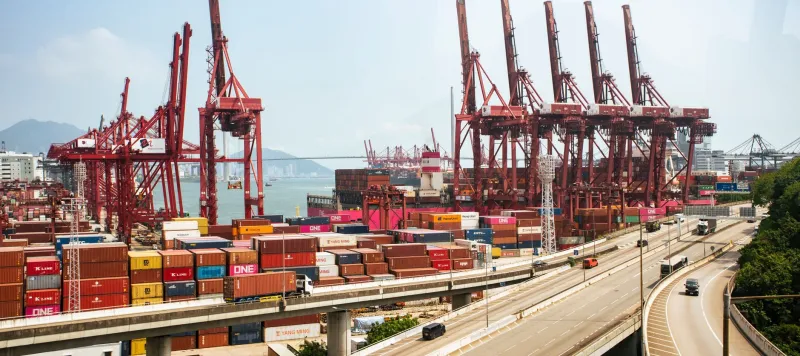
Photo: Hong Kong port container shipping logistics hub aerial view, via www.bubblypet.com
For most of the past two decades, the standard import playbook for UK brands sourcing from Asia followed a familiar sequence. Goods were manufactured, consolidated at origin, shipped to a UK port—typically Felixstowe or Southampton—cleared through customs, and delivered to a domestic distribution centre. From there, they moved to retail or fulfilment channels. The model was linear, predictable, and widely understood.
It was also, in many cases, quietly expensive.
A growing cohort of UK importers is now challenging this orthodoxy. Rather than treating the domestic warehouse as the first substantive node in their supply chain, they are inserting an earlier decision point—typically in Hong Kong or another regional hub—that allows them to direct goods more precisely, consolidate more efficiently, and respond to demand signals before goods are committed to a single market. The results, where implemented thoughtfully, have been measurable.
Why the Traditional Entry Model Creates Unnecessary Friction
The assumption that goods should travel from Asian factory to UK warehouse in a single, uninterrupted arc made sense when UK retail was predominantly domestic and supply chains were relatively stable. Neither condition holds as firmly today.
UK brands increasingly serve customers across multiple geographies simultaneously—mainland Europe, the Middle East, North America, and beyond. Routing all imported goods through a UK facility before redistributing them internationally adds cost, time, and handling that serves no commercial purpose. It also concentrates risk: a disruption at a UK port or domestic distribution centre becomes a constraint on the entire operation, regardless of which market is affected.
Beyond geography, the traditional model offers limited flexibility in terms of consolidation. Goods from multiple Asian suppliers often arrive on separate vessels, through different freight forwarders, and on misaligned timelines. The UK warehouse absorbs the cost of receiving, sorting, and reconciling these shipments. When volumes are high and timelines are tight, the inefficiency is manageable. When they are not, it becomes a source of avoidable cost.
The Regional Hub as an Earlier Decision Point
The alternative gaining traction among UK importers involves using a regional hub—most commonly Hong Kong—as the point at which goods from multiple suppliers are consolidated, inspected, and routed according to current demand rather than pre-committed schedules.
Hong Kong's utility in this context is not accidental. Its position at the intersection of major shipping lanes connecting mainland China, Southeast Asia, and onward routes to Europe and North America makes it a natural consolidation point. Its logistics infrastructure—bonded warehousing, freight forwarding, customs processing, and air freight connectivity—is mature and well-serviced. And its regulatory environment, while evolving, remains comparatively transparent for international businesses.
For a UK brand sourcing from three or four different suppliers across Guangdong and Fujian, consolidating in Hong Kong before a single deep-sea shipment to the UK is not merely a logistical convenience. It is a meaningful cost reduction. Fewer individual shipments, lower per-unit freight costs, and a single customs declaration on arrival in the UK replace a fragmented, administratively intensive process.
Case Study: A UK Homewares Brand Reconfigures Its Import Routing
Consider a mid-sized UK homewares brand that had historically managed its Asian sourcing through direct factory-to-UK shipments, with goods from five suppliers arriving independently across a six-week window each season. The administrative burden was substantial. Customs declarations, freight reconciliation, and warehouse receiving schedules consumed significant resource. Landed costs were also higher than anticipated, partly because small individual shipments attracted less favourable freight rates.
After working with a Hong Kong-based logistics partner to establish a consolidation arrangement, the brand redirected all five supplier outputs to a single Hong Kong facility. Goods were received, inspected against specification, and held until a full container load could be assembled for the UK market. A portion of stock destined for a European wholesale partner was routed directly from Hong Kong, bypassing the UK entirely.
The outcome was a reduction in per-unit landed cost to the UK of approximately 11 per cent, driven primarily by improved freight utilisation and reduced handling charges. Lead times for the European partner improved by nearly two weeks. And the brand's UK warehouse team reported a material reduction in receiving complexity, with a single, pre-consolidated shipment replacing five separate arrivals.
The investment required was modest: a revised logistics agreement, updated incoterms with two of the five suppliers, and a period of onboarding with the Hong Kong facility. The commercial return was immediate.
Port Selection and the Overlooked Variable
Alongside consolidation strategy, port selection deserves more deliberate attention than it typically receives. UK importers often default to established port relationships without revisiting whether those choices remain optimal. Felixstowe handles a significant proportion of UK container traffic, but it is not the only viable entry point, and for certain distribution networks, it may not be the most efficient one.
Brands with distribution centres in the North of England or Scotland may find that routing through the Port of Liverpool or the Humber ports reduces inland transport costs meaningfully. For goods destined for Ireland, routing through Dublin or Belfast may eliminate a cross-channel leg entirely. These are not novel observations, but they are frequently overlooked in the operational inertia of established import programmes.
When combined with a regional consolidation strategy that allows goods to be assembled and routed according to destination rather than origin, port selection becomes a genuine variable in margin management rather than a fixed administrative detail.
Multi-Market Entry and the Changing Shape of UK Brand Distribution
Perhaps the most significant implication of the smarter entry point strategy is its effect on how UK brands conceptualise their distribution geography. When Hong Kong functions as a regional staging point rather than merely a transit corridor, it becomes possible to serve multiple markets from a single inventory position—allocating stock to the UK, Europe, or other regions in response to real-time demand rather than pre-season commitments.
This is not a trivial capability. For brands managing seasonal products or trend-sensitive categories, the ability to redirect inventory at the consolidation stage—before it is committed to a specific market—can mean the difference between a profitable season and a costly one.
The shift in thinking required is less about technology or capital investment than about supply chain architecture. The question is not simply how goods move, but where the first meaningful decision in their journey is made. For an increasing number of UK importers, that decision is now made considerably earlier—and considerably further east—than it once was.