Frozen Capital: How UK Retailers Are Paying the Price for Post-Peak Asian Overstock

Photo: warehouse shelves excess inventory retail stock storage, via monde.ccdmd.qc.ca
Every January, a familiar anxiety settles across UK retail buying teams. The Christmas orders have shipped, the containers have cleared customs, and the sales figures are in. For many importers, those figures tell an uncomfortable story: too much product, too little demand, and a warehouse full of goods sourced months earlier from factories in Guangdong, Zhejiang, or Jiangsu.
The post-peak season paradox is not new. But in 2024 and into 2025, it has sharpened considerably. Demand volatility, shifting consumer behaviour, and the lingering effects of supply chain recalibration have left a disproportionate number of UK retailers holding Asian inventory long after their more agile competitors have moved on. The question is not simply how this happens—it is why so many businesses continue to allow it.
The Forecasting Gap That Nobody Wants to Own
At the heart of the problem is a forecasting model that has not kept pace with modern retail complexity. Many UK importers still rely on prior-year sales data supplemented by intuitive adjustments from buying teams. In a stable market, this approach is serviceable. In a market characterised by compressed trend cycles, inflationary pressure on consumer spending, and unpredictable promotional windows, it is dangerously inadequate.
The consequences compound quickly. A buying commitment placed with an Asian manufacturer six to eight months before peak season locks in volumes based on projections that may already be outdated by the time goods are produced. By the time those goods arrive at a UK distribution centre, the window for full-price selling may already be narrowing. What began as a calculated commercial decision becomes, in retrospect, an expensive overcommitment.
The costs are rarely confined to the obvious markdown. Storage charges accumulate. Working capital remains tied up in unsold units. Reorder capacity for the next season is constrained. And in categories where product relevance decays quickly—consumer electronics, seasonal fashion, licensed merchandise—the depreciation of unsold Asian-sourced stock is both rapid and largely irreversible.
What Competitors Are Doing Differently
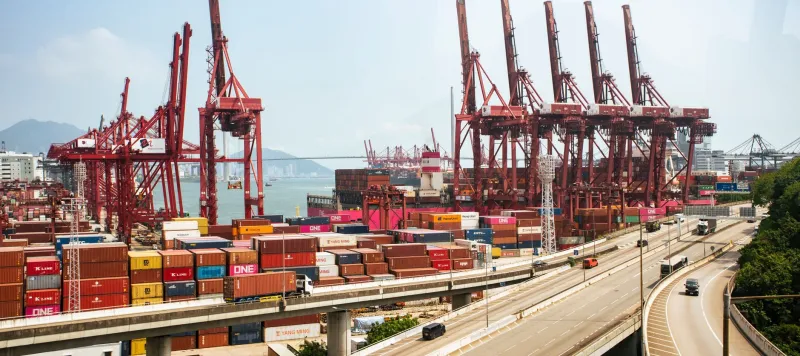
The retailers who appear to move on quickly after a poor peak season are not simply better forecasters. Many have restructured the physical geography of their inventory. Rather than committing all purchased stock to a single UK-based distribution centre at the point of manufacture, they are staging a portion of that inventory at consolidation warehouses in Hong Kong prior to onward shipment.
This approach—increasingly referred to as flex-stocking—creates a deliberate buffer between production commitment and market deployment. Goods are manufactured and moved to a Hong Kong holding facility, but final shipment to the UK (or to alternative markets) is deferred until demand signals are clearer. If UK sell-through rates are strong, stock flows forward. If they are not, the importer retains options that would otherwise have been foreclosed the moment goods cleared UK customs.
The logic is straightforward. Hong Kong's position as a mature logistics hub means that warehousing, quality inspection, and onward routing to multiple destinations—including mainland Europe, the Middle East, and Southeast Asia—can be arranged with relative efficiency. For importers who have historically treated Hong Kong purely as a transit point, reconsidering it as a strategic inventory node represents a meaningful operational shift.
The Hidden Arithmetic of Overcommitment
To appreciate why flex-stocking is gaining traction, it is worth examining what overcommitment actually costs. Consider a UK importer who purchases 10,000 units of a seasonal product from an Asian supplier at an average landed cost of £18 per unit. At full retail, the margin is healthy. But if 3,000 units remain unsold after peak season, the financial picture deteriorates sharply.
Those 3,000 units must be stored, often at UK warehouse rates that have increased substantially in recent years. They must eventually be liquidated—either through clearance channels at a fraction of original retail, or through secondary market platforms that carry their own fees and reputational considerations. In some cases, they are simply written off. The working capital tied up in those units is unavailable for the next season's buying cycle, creating a cascading constraint on commercial agility.
None of this appears on the original purchase order. It emerges gradually, in storage invoices, markdown approvals, and finance team conversations about cash flow. By the time the full cost is visible, the season is long over.
Unlocking Faster Liquidation Through Regional Positioning
One of the less-discussed advantages of holding inventory in Hong Kong rather than shipping it directly to the UK is access to regional liquidation channels. The Asia-Pacific market for branded goods—including UK and European labels—is substantial and growing. An importer holding excess stock in a Hong Kong facility has a materially different set of options compared to one whose goods are sitting in a Midlands distribution centre.
Regional buyers, parallel importers, and off-price retailers operating across Southeast Asia, Japan, South Korea, and the Middle East can often absorb overstock at better recovery rates than UK clearance channels. The proximity of Hong Kong to these markets, combined with its established freight infrastructure, means that repositioning unsold inventory is logistically feasible in a way that repatriation from the UK simply is not.
For UK importers, this is not a theoretical advantage. It is a practical mechanism for converting frozen capital into recoverable cash—provided the inventory is positioned correctly before the window closes.
Building Flexibility Into the Buying Calendar
Adopting a flex-stocking model requires adjustments to the buying calendar and supplier relationships. Manufacturers must be willing to accommodate phased release of finished goods rather than bulk shipment upon completion. Logistics partners must be capable of managing split consignments and conditional onward routing. And finance teams must be comfortable with a warehousing cost incurred in Hong Kong that, on paper, delays the point at which goods appear on a UK balance sheet.
These are not insurmountable challenges. But they do require deliberate planning and a willingness to treat inventory positioning as a strategic decision rather than a logistical afterthought.
For UK retailers who have absorbed the costs of post-peak overstock more than once, the case for change is compelling. The post-peak paradox is not an act of commercial misfortune. In most cases, it is the predictable outcome of a supply chain architecture that was never designed to accommodate uncertainty. Addressing it means rethinking not just how goods are bought, but where they wait before they are sold.